Today we need to discuss Assata, and then do the following with MLK's "Letter from the Birmingham Jail" - explain MLK's main thesis in the piece and how he goes about achieving it. List some rhetorical devices that MLK uses, and list examples of logos, pathos, ethos. Final SOAPStone
Today we will finish reading “Letter from the Birmingham Jail” by Martin Luther King Jr..
Remember to mark the following, ethos, pathos, logos,
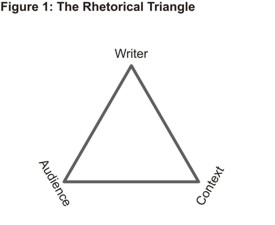
rhetorical devices, and think about the rhetorical triangle. You will probably have to write something about this essay tomorrow.
Today we are going to discuss Assata, go over some notes on Chapter 1 of The Language of Composition, look at types of syntax, and read “Letter from the Birmingham Jail” by Martin Luther King Jr..
For the reading I would you to mark the following, ethos, pathos, logos, rhetorical devices, and think about the rhetorical triangle.
HW: Assata to page 160.
^^^^ The Rhetorical Triangle (Aristotle)
What in the World is Rhetoric???
Well, according to the book, rhetoric
is "a thoughtful, reflective activity leading to effective
communication, including rational exchange of opposing viewpoints." This
to me sounds like the act of opening your mouth and conversing, or
perhaps, debating with someone.
KEY ELEMENTS:
-Context The
context is the occasion that the essay/speech was given. This can be
somewhat like the setting of a story, and by knowing this, you can
properly assess who the intended audience is and whether or not the
context increases the effectivity of the piece.
-Purpose The goal
that the speaker/writer/author wanted to achieve. This coincides with
the context and allows the writer to choose the best possible audience
in which to present the piece.
-Thesis/claim/assertion This could be the
-Subject What the
piece is about, the topic, y'know... so the author should have a very
good grasp on what he/she/it wants to talk about in order to express the
ideas/comments thoroughly and with as much consistency as possible.
Ethos:
Ethos is the character of the writer or the speaker. Good ethos is when
the writer presents his/her/itself as a classy individual while also
coming off as "credible and trustworthy". Allowing the audience to
connect with the author is something that really helps push the point
across and deliver the best results for giving a great speech/rhetoric.
Logos: Logos
is the appeal to logic/reason, by offering the audience clear and
easy-ro-understand ideas that make as much sense as possible, while
remaining rational. Presenting a main idea in a concise manner, showing
another side/counterargument, credible statistics and facts, and/or
expert testimony. (See "Things Fielding told us to include in Persuasive
Essays.")
Pathos: Pathos
is the appeal to emotion. While this isn't something that should be
emphasized as it can come off as propaganda which is not what you want.
Appealing to the emotions means using vivid word choice that can easily
stimulate the readers' thoughts and using the first-person perspective.
The Classical Arrangement of Rhetoric:
1. Introduction (exordium)
-Brings
the reader into the discussion, emerging them into the world of
rhetoric. Introductions can be a couple short sentences, or several
lengthy paragraphs (pages...!). Drawing the reader in is important
(hook) and presenting the main idea (thesis statement) and stating the
order of development. Normally, this is where the author would establish
ethos.
2. Narration (narratio)
-Factual
information is presented and background information give the reader
that much more insight into the subject. This is typically when you
would begin to appeal to logos, yet it is smart to consider appealing to
pathos as you are inclined to evoke an emotional response form the
reader so that they can firmly decide on your opinion with the facts and
statements you present.
3. Confirmation (confirmatio)
-A
large portion of the writing that sets up the proof of your argument
and why the audience should agree. The details in this section should be
strong and thorough, while making the biggest appeal to logos in this
section.
4. Refutation (refutatio)
-This
part of the writing takes a look at the other side of the topic, the
counterargument, if you want to call it that. Used as a "bridge between
the writer's proof and conclusion" but also as appeal to ethos, as the
audience can see that you are passionate enough about your subject that
you chose to research both sides to get as informed as possible.
5.Conclusion (peroratio)
-Closing
the essay, appealing to pathos one final time as well as connecting
with ethos set up in the beginning of the piece. Instead of repeating
what has already been said (guilty of this on several occasions... :l ),
the writer's ideas should all get compacted into one and "answers the
question, so what?" The last words are usually the ones that the
audience is going to remember, so make them count. Throw it all out on
the table and sum up the essay with as much intelligence as possible!
Patterns of Development: Authors
can change their arrangement by writing in order of purpose. Each
method of writing purposefully has its own way of organizing thoughts
and piecing together all the little eccentricities neatly and
professionally.
Types of Essays We'll Be Writing: Narration: Tells a story and
recounts tales of slaying dragons and mystical creatures. Not really,
but narration is typically a recollection of previous events, usually
chronologically, or as a means to enter into the main idea of an essay.
Description: Much like narration and
just as detailed (if not, more so), but the details focus more on the
sensory responses from the readers. These include, the ways things
taste, the sounds around the writer, textures and feelings, sights,
colours, setting up an atmosphere for the piece. The descriptive
language is a way to help make thoughts more approachable to the readers
and helps in being more persuasive. ProcessAnalysis: An
explanation. A how-to. The steps on how to achieve something or engage
in a process. These can best be found in (according to the book)
self-help books. Because these are going to help the way someone lives
or acts, you must be as clear as possible in the instruction with
smooth, flowing transitions as to not miss a step or confuse anyone. Exemplification: Hopefully, this is
readable... Facts, examples, testimonies are all ways to make an idea
complete. With complete ideas, come more acceptable readers and easier
persuasion. Comparison and Contrast: Highlighting
similarities and differences in an organized fashion allows clear
presentation of points that can be easy to digest for the audience. With
careful analytics, the author can find interesting tidbits of
information that could open up ideas to readers that otherwise couldn't
be achieved, as well as highlighting both sides of an argument or
multiple angles of a topic. Classification and Division: Sorting
information into how topics go together and why. Connections can be
made between things that are seemingly unrelated and thus, like
Comparison and Contrast, can reveal difference aspects to the reader
that otherwise were unknown. Definition: Defining something can
allow more points to come through and allow "meaningful conversation".
Example: (See what I'm doing here?) Let's talk about how awesome
alligators are. But before we do this, we must DEFINE what counts as "awesome". Perhaps a dictionary definition. Cause and Effect: Causes and
Effects. Self explanitory... "The effects that result from a cause is a
powerful foundation for argument." Seems legit.
Today we need to discuss what your read for Assata, discuss "No Name Woman", and finally write a Precise for "No Name Woman", but first we need to watch the next video on AP Classroom.
Homework: Next two chapters in Assata (page 140?). Note, the goal is to finish Assata by the end of next week.
Today I'm going to give you a few minutes to finish AP Classroom, then we will discuss what you wrote about on your Assata assignment, watch the next AP Classroom video, and finally read "No Name Woman". We will discuss this in class and you will probably write a precise about it tomorrow in class.
Today we need to finish chapter one of The Language of Composition. Then we need to do the assigned questions on AP Classroom. Please turn in your precise. We will quickly discuss them and move on.
There is no reading homework tonight.
HW: (For Tuesday) Write a summary outline of Assata's autobiography, and
discuss one major theme of the book, and an detail example of a scene of
how that theme works, and discuss the author's purpose in writing the
book as a whole. You also need to discuss strategies Assata uses to bring
out her ideas (structure, use of syntax or diction, use of imagery, use
of metaphors or symbols, etc).
We will discuss "Flying the Friendly Skies" and Assata. We will also finish chapter 1 of THE LANGUAGE of COMPOSITION (note if we do not finish this chapter you will need to do it for homework).
Homework for Friday/Monday:
1) Write a precise for "Flying the Friendly Skies"
2) Read chapter 5 of Assata
2) (For Tuesday) Write a summary outline of Assata's autobiography, and
discuss one major theme of the book, and an detail example of a scene of
how that theme works, and discuss the author's purpose in writing the
book as a whole. You also need to discuss strategies Assata uses to bring
out her ideas (structure, use of syntax or diction, use of imagery, use
of metaphors or symbols, etc).
Today, I will give you a few minutes to finish your Precis in class. Then will will discuss what you came up with. Discuss Assata. Then look at another example of precis writing - either "Fly the Friendly Skies" or "No Named Woman"
Name of author, [optional: a phrase describing author], genre, title of the work, date in
parentheses (additional publishing information in parentheses or note); a rhetorically
accurate verb (such as “assert,” “argue,” “suggest,” “imply,” “claim,” etc.); and a
that clause containing the major assertion (thesis statement) of the work. First - AP Classroom.
An explanation of how the author develops and/or supports the thesis, usually in
chronological order.
A statement of the author’s apparent purpose followed by an “in order to” phrase.
A description of the intended audience (and/or the relationship the author establishes
with the audience) and a description of his or her tone.
Today we are going to discuss chapter 1 of Assata - particularly her use of rhetorical devices, look at thesis statements (perhaps come up with a thesis statement for chapter 1 of Assata), read "The Ugly Truth About Beauty" and discuss precis writing.
Read "The Ugly Truth About Beauty" By Dave Barry
-Written work 1.) Discuss thesis, point of view, audience, and Purpose. 2.) What claims does the essay make about beauty?
Unit 1 - Here are the things you should know and be able to do
Essential Understandings:
1)Individuals write within a particular situation
and make strategic writing choices based on that situation.
2)Writers make claims about subjects, rely on
evidence that supports reasoning that justifies the claim, and often
acknowledge or respond to other, possibly opposing arguments.
Skills
1)Reading – identify and describe components of
the rhetorical situation: the exigence (the reason for
the writer or speaker to present the issue or problem), audience, writer,
purpose, context, and message.
2)Reading – identify and explain claims and
evidence within an argument.
3)Writing – Develop a paragraph that includes a
claim and evidence supporting the claim.
Essential Knowledge:
1)An audience of a text has shared as well as
individual beliefs, values, needs, and backgrounds.
2)Writers create texts within a particular context
that includes time, place, and occasion.
3)Writers convey their positions through one or
more claims that require a defense.
4)Writers defend their claims with evidence and/or
reasoning.
5)Types of evidence may include facts, anecdotes,
analogies, statistics, examples, details, illustrations, expert opinions,
personal observations, personal experiences, testimonies, or experiments.
6)Effective claims provoke interest and require a
defense, rather than simply stating an obvious, known fact that requires no
defense or justification.
7)Writers relate source material to their own
argument by syntactically embedding particular quoted, paraphrased, or
summarized information from one or more sources into their own ideas.
The purpose of this course is to help students “write
effectively and confidently in their college courses across the curriculum and
in their professional lives.” (The College Board, AP English Course Description p. 6)In addition the purpose of the course is to “emphasize the expository,
analytical and argumentative writing that forms the basis of academic and
professional communication” (p. 6).In
order to do this the class will read/explore various nonfiction writing that
offer students a chance to explain the authors’ use of rhetorical strategies
and techniques.These readings provide
models for the student’s own writing.As
defined by David Jolliffe, a former AP exam creator, AP English Language and
Composition is a college-level course examining rhetoric as “the art of finding
and analyzing all the choices involving language that a writer, speaker,
reader, or listener might make in a situation so that the text becomes
meaningful, purposeful, and effective for readers or listeners, and examining
the specific features of texts, written or spoken that cause them to be
meaningful, purposeful, and effective for readers or listeners in a
situation.”In addition to readings
students will be required to analyze graphs, political cartoons, photographs,
and video media weekly.They will also
be required to keep a blog to record their reactions to media and to post
“short writes”, précises and prewriting work.
Learners Goals:By
the end of the course students will understand
·the main point or thesis, the occasion or
context, the motivation, the tone and style of a piece of writing
·how a text is created to develop meaning and
purpose including genre, organization, and syntax
·the relationship of text’s creation to its
accomplishment, meaning and effect
·how to articulate an analysis of what they read
·how to create, develop and support an argument,
acknowledging the complexities and nuances of important issues that adults
argue about in contemporary intellectual circles
·that good citizenship is about being aware of
public discourse issues
·how to develop a thesis and argument or
exposition by synthesizing information from many places into their writing
·how to analyze visual texts and use this
analyzes in their own writing
·how to cite information in proper MLA format
(Many of these goals come directly from successful
AP teacher, Mr. Rolf M. Gunnar, http://www.mrgunnar.net).
Writing
Assignments
Most of following writing assignments will be developed,
reviewed and discussed, in class but primarily written outside of class.Each essay will go through many drafts that
will be feature a self-evaluation, a peer review and a teacher-student
review.
·
·Real World Analysis/Oration: Students read
current event articles and research an issue or problem of their interest and
write an analysis or an oration concerning it.These will be presented to a larger audience..
·Synthesis Essay: Students synthesize materials
from a number of sources (including visual) to develop an argument and compose
an argumentative essay.
·Research Essay.To help students understand the process of conducting research,
gathering and synthesizing information from a variety of sources, and
incorporating MLA citation.
·Analytical Essay: Students compose a rhetorical
analysis from a prompt focusing on one of their readings.
·
MODES Project (developed by Valerie Stevenson
and presented at the AP by the Sea Summer Institute in San Diego, July 2012):
This project allows students to explore six modes of writing – narration,
analysis, compare and contrast, classification, definition, and persuasion –
first by reading essays and writing rhetorical précis on each mode, and then by
choosing one topic and writing an essay from each mode on that topic.
In addition to the above essays,
students will write In-class Timed essays, responding to AP or AP-like
prompts.Initially, these timed essays
will be shared in groups and revised.As
the year progresses, the essays will be discussed and assessed but without the
ability to revise.
Vocabulary:
Students will be given bi-weekly
vocabulary based on SAT words and words from assignment readings.
Grammar/Structure/Style:
Students will review and use in
their writing transitions, various types of phrases (appositive phrases,
participial phrases, absolute phrases), parallelism,various
types of sentence structures (simple, complex, compound, complex-compound,
periodic), irony, metaphor, alliteration, simile, hyperbole, litotes, among
others.
Strategies:
To help students analysis both written and visual materials
they we learn various strategies including SOAPSTone (developed by Tommy
Boley); Rhetorical Precis writing and checklist (developed by Chris Baris, Mark
Frerichs, Therese Frerichs and Valerie Stevenson); Syntax Analysis Chart; Dialectical
Journal writing; and, Overview-Parts-Title-Interrelationships-Conclusion
(OPTIC).Each of these is described in
more detail at the end of this syllabus.
Required Textbooks (we will read some of the following):
Diyanni, Robert – One Hundred Great Essays 4th
Edition.
Haley, Alex and Malcom X.The
Autobiography of Malcolm X.
Roskelly and Jolliffe – Everyday Use 2nd Edition.
Shea, Renee, Lawrence Scanlon and
Robin Dissin Aufses – The Language of
Composition
Trimmer and Hairston, eds. – The Riverside Reader 9th
Edition.
Modern Language Association – MLA Handbook for Writers of Research Papers
7th
Edition
Thoreau, Henry
David. Walden
Shakur,
Assata.Assata, An Autobiography
Daivs, Angela.An Autobiography
Maxine Hong Kingston The Woman Warrior
First Quarter: An Introduction to Rhetoric
The Language of
Composition chapters 1-3(pages
1-84)
Everyday Use
chapter 1-3 (pages 1-85)
“On Seeing England for the First Time” by Jamaica Kincaid
“Why We Crave Horror Movies” by Stephen King
“Shooting An Elephant” by George Orwell
“A Modest Proposal” by Jonathan Swift
“The Allegory of the Cave” by Plato
“The Libido for the Ugly” by H.L. Mencken
“Why I Went Into the Woods” by Henry David Thoreau
Assata: An
Autobiograhpy by Assata Shakur
In-class activities:
·Close reading and annotation
·Hand-outs and practice writing Rhetorical Precis
and SOAPSTone
·Group and individual analysis of readings
·Analyze the “keys”: persona, appeals, subject
matter and treatment, context, intention, and genre
·Writers workshop – grammar and style exercises
·Group editing and assessment sessions
·Vocabulary lists
Journal Assignments:
Each week students are responsible for writing one short
response (250-500 words) to a reading assignment or a particular quote in which
they provide a clear explanation of the writer’s assertion, and then defend or
challenge it.These will be posted on
their blogs where other students will have a chance to comment on their
position.As we progress in the quarter
these responses will sometimes be Rhetorical Precis of readings.
Further, each week, students will need to find two news
sources on the same subject.One of
these must come from a television/video source such as CNN News, Democracy
Now!, or Fox News, and the other must be a written source coming from an on-line
newspaper or news blog.Students are
required to write a short (200-300 words) analysis of these news items noting
point of view, claims or thesis, major points and write a defense or
challenge.
Writing Assignments:
Analysis/Oration (explained above)
2 – In-class Timed Essays addressing AP prompts
The Personal Narrative and Analysis/Oration will be graded
on rubrics developed by the instructor.Each essay will go through at least three drafts and will receive feedback
from peers and the teacher.The In-class
Timed Essay will be graded on the AP essay rubric and will be work-shopped in
groups and rewritten, and then scored a second time.
Second Quarter: A Study of Justice or Civil Rights and
Responsibilities
Everyday Use
chapters 4-6 (pages 93-153)
“The Times They Are a-Changin’” by Bob Dylan
“Ain’t I a Woman?” by Sojourner Truth
“Civil Disobedience” by Henry David Thoreau
“Letter from the Birmingham Jail” by Martin Luther King Jr.
“The Position of Poverty” by John Kenneth Galbraith
“Notes of a Native Son” by James Baldwin
“The Gettysburg Address” by Abraham Lincoln
“Second Inaugural Address” by Abraham Lincoln
“How It Feels to be Colored Me” by Zora Neale Hurston
“A Vindication of the Rights of Woman” by Mary
Wollstonecraft
“Speech on the Signing of the Treaty of Port Elliott” by
Chief Seattle
“The Declaration of Independence” by Thomas Jefferson
The Autobiography of
Malcolm X by Alex Haley and Malcolm X
Walden by Henry David Thoreau
In-class activities:
·Analyzing appeals to logos, pathos, and ethos
·Hand-outs on keeping a Dialectical Journal and OPTIC
·Group and individual analysis of readings
·Writers workshop – grammar and style exercises
·Group edition and assessment sessions
·Vocabulary lists
·Film clips: “I Have A Dream” by Martin Luther
King Jr., National Forensic League: Orations from National Championships, The Heart of the Game
·Delivery of Orations written in Quarter 1 and
in-class election
Journal WRITING:
Students will continue to write précis on selected readings
and on all film clips.Further, they
will keep their dialectical journal on The
Autobiography of Malcolm X on their blog so that it can be reviewed and
commented on by the teacher while in-process, and by fellow classmates.They will do 1 media write up (like quarter
1) every two weeks.
Writing Assignments:
Synthesis Essay on a topic of the students choice that
relates to the theme of Justice and Civil Rights.Students must use at least five sources, one
of which must be visual – either a chart, photography, political cartoon,
video, etc.All sources must be cited in
MLA format.The essay will go through
multiple drafts.
Analytical Essay – explained above, a response to a prompt
based on one of the assigned readings.
2 In-class Timed Essays based on AP prompts.
The Synthesis and Analytical Essay will be graded on rubrics
developed by the instructor.The
In-class Timed Essays will be graded on the AP rubric.
Quarter Three: THE MODES PROJECT (developed by Valerie
Stevenson and M. Frerichs)
·Everyday
Use chapter 7
·“The Conversation” by Wendy Lesser
·“The Keyboard” by William Zinsser
·“The Golden Spike” by John Steele Gordon
·“Selected Web Sites” by Dave Barry
·“Women and Children First: Gender and Settling
of the Electronic Frontier” by Laura Miller
·“Welcome to Cyberbia” by M. Kadi
·“Looking for Community on the Internet” by Evan
I Scharz
PROJECT OVERVIEW
1)Student will read “Resources for Writing”
(Thematic Unit – The Internet) in their Riverside
Reader pages 549 – 649.
The purpose of this aspect of the assignment is to further
their understanding of seven different rhetorical modes of development and to
show them a model for the writing project that they will be doing.Reading the selections, which are all on the
same topic, the Internet, but which utilize the various “modes of development”.
2)Read two additional essays of their choice of
each mode and write a précis (posted on their blog) for each.These readings should come from The Riverside Reader.While students are doing this aspect of the
project the class will be studying and working with various modes in class.
3)Write six papers on the same topic, each in a
different mode.
Each paper should clearly demonstrate the distinct
characteristics of the mode.Before
writing the student should review the different chapters for tips on purpose,
audience, strategies, and in some cases, potential pitfalls.Especially important will be the “Points to
Remember” charts handed out during the writing.
Students will choose a topic that is well known and
interesting to them and broad enough that they can readily adapt it to six
different treatments:1) narration, 2)
analysis, 3) compare and contrast, 4) classification, 5) definition, and 6)
persuasion
Topics that have be suggested include: shopping, a favorite
sport, school, friends, teenagers, grades, parents, teacher, TV, movies,
reading, dating, music, holidays, fashion, presidential elections, politics,
religion, vegetarianism, health, food or cooking, nature, etc.
Each paper should be approximately 500 words, labeled with
the mode of development, double-spaced, typed, have a creative title, and a
word count at the end.
Total project should be approximately 3000 words.
Each paper will be work-shopped in a group setting and
discussed 1-1 with teacher.
Journals: During this quarter journals will function as a writer’s
journal.Students will be required to
post pre-writing, reflections, comments on the writing process, ideas and
concerns.During this quarter, students
will be writers fully engaged in the writing process.Three blogs entries will be due each week.
Assignments:
·Reading test on Thematic unit on the Internet.
·Independent Reading and Precis Writing
·Writing the Seven Modes
·Blogs
·
Vocabulary Lists
Quarter Four: The Research Paper and Preparing for the AP
test.
·“The Communist Manifesto” by Karl Marx and
Friedrich Engels
·“On Ben Franklin’s Virtues” by D. H. Lawrence
·“Me Talk Pretty One Day” by David Sedaris
·“A Woman’s Beauty: Put-Down or Power Source?” by
Susan Susan Sontag
·“Nonverbal/Verbal” by Leonard Shlain
·“Mother Tongue” by Amy Tan
·“Superman and Me” by Sherman Alexie
·Selections from the MLA Handbook Angela
Davis: An Autobiography (this might be a suggested reading)
Assignments:
·AP multiple choice questions/exercises
·Precis on selected readings
·Vocabulary Lists
·Writer’s Workshop – grammar and style exercises
·Group discussions of topics and theses;
determining viability of research topic
·Library: gathering information and ideas from
diverse sources
·Saturday morning PRACTICE AP LANUAGE TEST
Journals:
During this quarter journals will be the place students begin
to list their sources and notes for their research essay.I expect to see three entries per week.
Writing:
Research Paper: Three drafts of a researched argumentative
or expository paper synthesizing diverse sources and cited in MLA format.
3 AP In-class Writing Prompts.
The research essay will be graded on a rubric developed by
the instructor.The AP In-class writing
prompts will be graded on the AP rubric.
During this quarter students will also be encouraged to read
and review 5 Steps To A 5 by Barbara
L. Murphy and Estelle M. Rankin.The
school has copies of the 2012-2013 book that can be borrowed.